
Find Montgomery County Residents Carefully
Montgomery County has no public list of every person at every address. MCAD records an appraisal owner or contact and a parcel. The County Clerk records parties to deeds and other instruments. Elections records support a registration-status or street question. Library and archive collections can associate a person with an earlier printed address. Each source states a role and a date, not a full account of who lives at a property.
Begin with the fact already known. An address can lead to a parcel and legal description. A full name and time period may point to a deed, court file, directory, newspaper, or vital index. A missing result can reflect a spelling variant, suppressed address, entity owner, parcel change, or portal limit. Save stable keys instead of relying on a name alone.
- Use MCAD for the parcel, listed owner, situs, and legal description.
- Confirm a deed trail through the County Clerk index.
- Use election tools only for their documented registration or street purpose.
- Check library and archive material for historical association.
- Request a specific existing record from the custodian when an online index ends.
Montgomery County Resident Records Desks
MCAD, the County Clerk, and the Elections Administrator are distinct Montgomery County records desks. MCAD is the appraisal source; the Clerk holds official property records and county record categories; Elections maintains the voter database and street database. A mailing address, property party, and election status are different facts. Street-by-street research is handled in the Montgomery County by-street directory.
Montgomery Central Appraisal District
109 Gladstell St.
Conroe, TX 77301
936-756-3354
Search Montgomery County Parcels
MCAD search labels include appraisal year, owner, address, Property ID, account, legal description, subdivision, abstract, market area, and map search. A parcel card separates the situs, or property location, from an owner mailing address. A mailing address can be an agent, entity, or tax correspondence address and does not prove residence. Carry the Property ID and legal description into the next record family.
| Field | Use | Limit |
|---|---|---|
| Owner Name | Find an appraisal account | Not proof of occupancy |
| Address Search | Find a situs parcel | Try simplified street wording |
| Property ID | Preserve a stable key | Appraisal key, not title |
| Legal Description | Join lot, block, subdivision, or abstract | May differ from street wording |
- Parcel
- A mapped unit of land used for appraisal administration.
- Situs
- The property location, distinct from a mailing address.
- Index
- A record list that points toward a document.
Current Montgomery County Resident Rolls
Current Montgomery County directory evidence is partial by design. MCAD can connect a listed owner or contact to a parcel. The Clerk index can connect parties to a recorded transaction. The election route can answer a registration-status or street search. County court modules can route a party-name matter. Match role, date, address type, and a second source before drawing a conclusion.
| Record route | What it shows | Access |
|---|---|---|
| MCAD account | Parcel, owner/contact, situs, legal description | Public portal and office |
| Official Records | Recorded parties, instrument, and date | Index, copies, counter |
| Election street route | Address search route and status context | Street form and registrar |
| MCMLS collections | Historical published association | Library and archive channels |
A name-based question can use the Montgomery County resident lookup to compare record families without treating one result as final proof.
Trace Montgomery County Deed Records
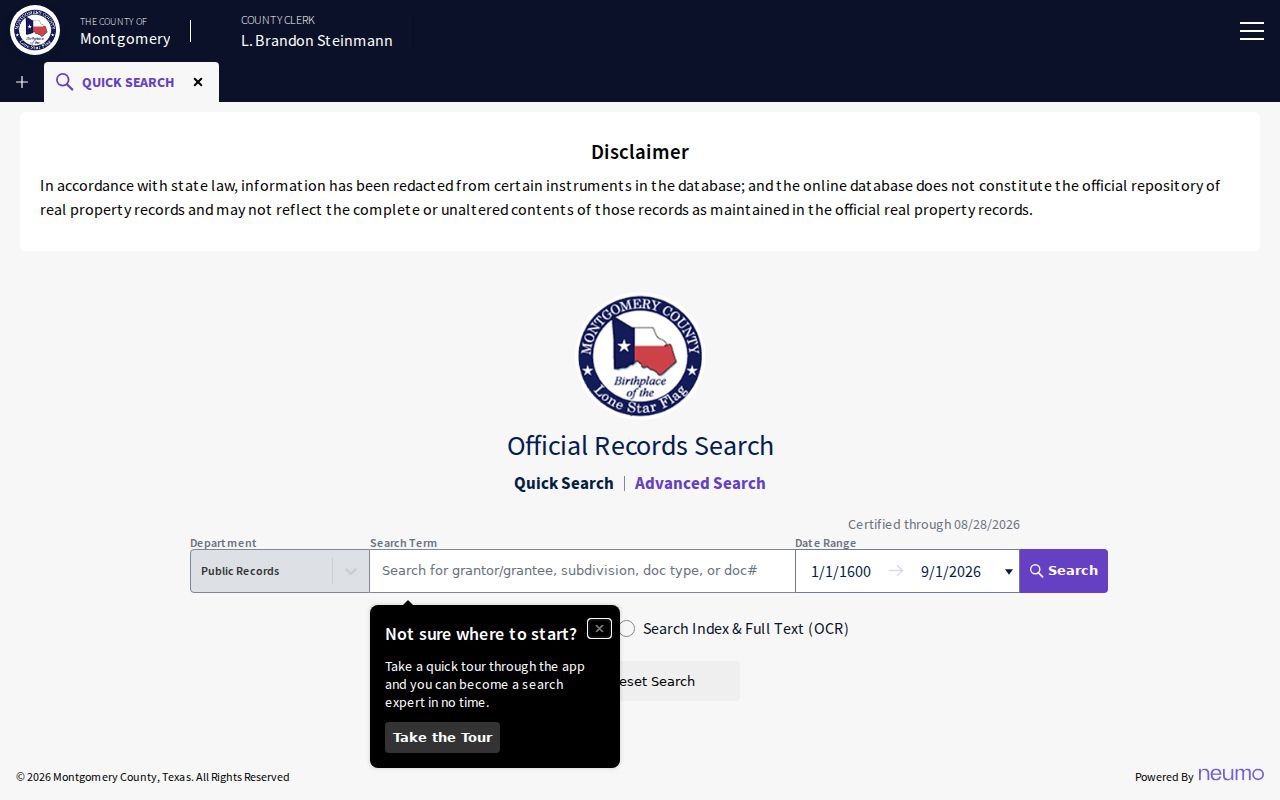
The County Clerk Official Records Search provides a search term, recorded-date range, quick date ranges, an image control, and index-only or index-and-full-text OCR scope. Use a grantor, grantee, subdivision, document type, document number, or date range. An instrument may document an interest or transaction, not continuous residence.
The researched screen was certified through August 27, 2026 and did not state an online historical start date. TSLAC confirms Montgomery County deed records from 1838 to 1887 and direct/reverse indexes on reels 1006024 and 1006025. For a known record, the Clerk copy form documents a 24 to 72 hour turnaround, $1 per plain page, and $5 certification surcharge.
The County Clerk index is the source for the search controls described here.
Check Montgomery County Election Routes
The Election Street Database accepts House Number, Street Name, and ZIP Code. Its instructions say to omit direction and street type from the street field and permit partial street terms. The account-gated public-information portal is a separate route. Registered, Suspense, Pending Approval, and Awaiting Voter Response are administrative labels, not a household census or ownership finding.
Texas rules protect Social Security, driver-license, and DPS identification numbers. Qualifying participants in address-confidentiality programs can have address data suppressed. Do not infer a protected address from another record or combine public fields into a personal dossier.
Route Montgomery County Courts and Vitals
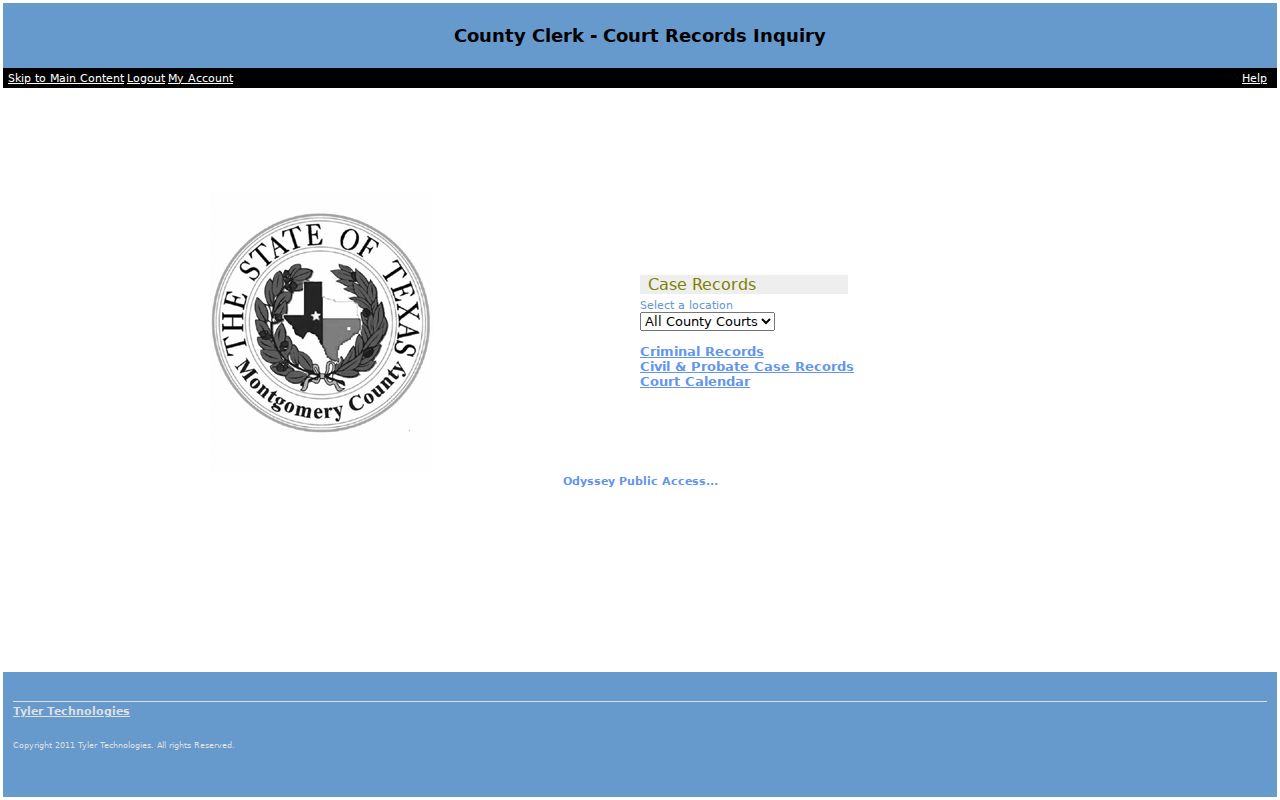
The County Clerk Odyssey landing page routes Criminal Records, Civil & Probate Case Records, and Court Calendar. District Clerk access was login-gated when researched, so a clerk request or counter may be needed. A court hit needs the cause number, party role, court, date, and disposition. It is not identity proof or a finding of guilt.
DSHS handles state birth/death copies and verification and marriage/divorce verification. The Clerk controls certified Montgomery County marriage licenses; the District Clerk controls certified divorce decrees. Birth records become public after 75 years and death records after 25 years under Texas Government Code §552.115, while recent certified copies remain subject to eligibility rules.
The Odyssey source shows the county-court modules inspected for the directory.
Explore Historical Montgomery County Directories
TSLAC lists confirmed Conroe city-directory years for 1984, 1988, 1990, and 1992. Those are catalog facts, not proof that every intervening edition was published or survives. A local entry and abbreviation key were not inspected, so a line in a directory is a dated published association rather than a guaranteed residence. The Montgomery County city directories collection explains the historical shelf.
The MCMLS Genealogy & Local History Room at Central Library offers a human-assisted route to books, maps, newspapers, and local-history material. Its Portal to Texas History partner collection showed 584 items at inspection, including 562 Conroe Courier items in the newspaper grouping. For early work, TSLAC lists deeds, marriage, probate, civil minutes, surveys, and tax rolls on Montgomery microfilm.
Understand Montgomery County Record Geography
Montgomery County contains 23 ZIP codes in the researched state appendix. A postal city can differ from a mapped municipality, subdivision, or county jurisdiction. The Woodlands often uses Spring postal labels, while a parcel or subdivision uses another local term. Use USPS for delivery, GIS city-limits/ETJ layers for municipal questions, and county records for county jurisdiction. A ZIP alone does not prove city residence.
The public MCAD parcel service and Conroe basemap provide parcel, street, subdivision, city-limit, ETJ, and surrounding-community context. They identify locations, not relationships between people. Historic Conroe research also has a seven-sheet 1923 Sanborn set and a nine-sheet 1938 to 1943 set at the Library of Congress.
Use Montgomery County Record Fallbacks
Texas Public Information Act requests seek existing records, not a new directory or an answer to a general question. Under chapter 552, an office responds promptly and, if production will take more than ten business days, §552.221 calls for a notice and reasonable availability date. A cost estimate is required when charges exceed $40. Inspection, counter terminals, a known-record copy request, phone contact, library research, and a focused written request are different access channels.
The County Clerk service page is the official routing source for county record work.

Respect Montgomery County Live Roster Limits
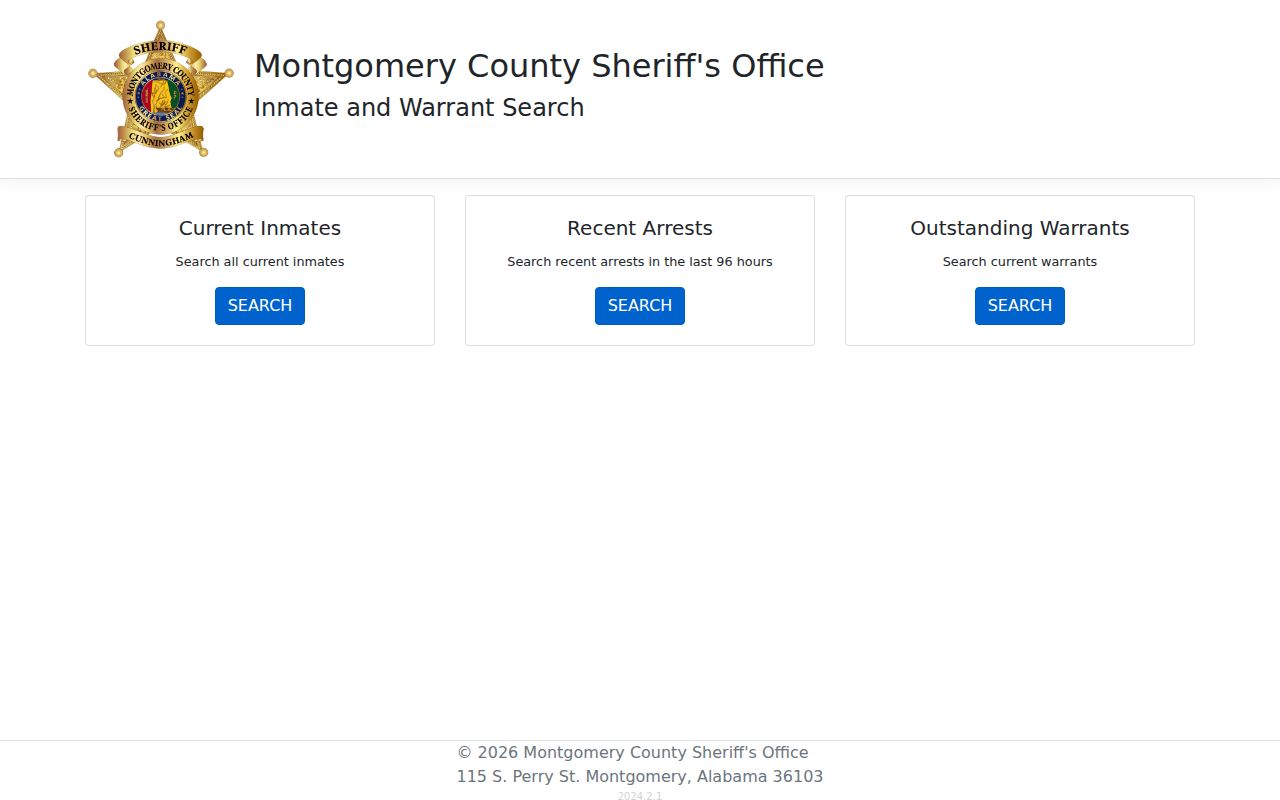
The Sheriff's official portal has Current Inmates, Recent Arrests from the last 96 hours, and Outstanding Warrants modules. It is a changing operational resource, not a residents directory or an archive. The detailed search fields were not captured, so no result details should be assumed. Verify a legal matter through the proper court and do not treat a booking or warrant as a finding of guilt.
The Sheriff's official search page documents the live module categories.
Montgomery County Records Beyond the Screen
A Montgomery County search that reaches beyond a current portal needs a date, a record type, and often a repository plan. The county was created on December 14, 1837, and its county seat moved from Montgomery to Conroe after an 1889 election. The 1933 courthouse fire damaged the upstairs courtroom, but preservation material says citizens saved records. That history does not establish that a particular file was lost or saved. It does explain why older research may lead to clerk volumes, state microfilm, and local-library collections instead of a single modern result screen.
The Texas State Library and Archives Commission Montgomery County guide identifies several deep record runs. Its deed records span 1838 to 1887, with direct and reverse deed indexes on reels 1006024 and 1006025. The guide also lists marriage records from 1838 to 1916, probate minutes from 1838 to 1906, district-court civil minutes beginning in 1839, and tax rolls from 1838 to 1910. A reel citation is a retrieval key, not a promise that every page is online. Ask the repository or library which access channel applies before planning a visit or copy request.
| Montgomery County source | Confirmed span | Useful research role |
|---|---|---|
| Deed records | 1838-1887 | Recorded land interests and deed-chain leads |
| Marriage records | 1838-1916 | Historic household and family-history leads |
| Probate minutes | 1838-1906 | Estate and heir research |
| Tax rolls | 1838-1910 | Dated landowner and property context |
Volume details matter. The TSLAC guide notes that deed volumes G and I are absent from its listed run, and that one probate volume carries an unusual transcription note. A missing letter or reel therefore is not enough to declare a search unsuccessful. Keep the volume, reel, date, and spelling used in each search note, then ask the custodian or archive about the next available source.
The Montgomery County Memorial Library System partner collection adds a local research route. Its Genealogy and Preservation Center began in 1976, and a 2026 State Library profile describes roughly 40,000 maps, records, books, and rare or out-of-print materials in a 5,000-square-foot space. Staff, catalog terms, vertical files, newspapers, maps, yearbooks, and microfilm can help bridge a gap between a current parcel record and an older family or address trail. Confirm the relevant holding and access conditions before relying on a planned visit.
Montgomery County Request and Alert Limits
Texas access law opens existing public information, but it does not require a county or city office to create a new household list, answer a broad question, or release information made confidential by another law. A written request to the governmental body activates the Texas Public Information Act. The request should identify the record, date range, address, instrument number, case number, or other available key. Under Tex. Gov't Code ch. 552, including §§ 552.021, 552.221, and 552.261, access and charges remain subject to statutory limits and the custodian's procedures.
- Name the existing Montgomery County record sought, rather than asking an office to research a person or assemble a directory.
- Include the best available date, address, legal description, document number, or case number.
- Ask whether inspection, a plain copy, a certified copy, or an in-person terminal is the appropriate channel.
- Expect a reasonable availability date if production cannot occur within ten business days.
- Read a cost estimate before approving work when charges exceed $40.
The Texas Attorney General's Public Information Act overview explains the statewide request route. A County Clerk copy form can be better when the document is already known, while a targeted public-information request can be more useful for a record that has no searchable online index. The distinction prevents a general request from being treated as a demand for a new search product.
Some official databases supply a different kind of lead. SOSDirect offers entity, assumed-name, filing-number, person, and registered-agent searches. Its results can associate a name with a filed business role or address, but they do not establish that the person lives in Montgomery County. Preserve the filing number and filing date, then compare any location question with the County Clerk, appraisal, or local permit record that matches the purpose of the search.
Recent monitoring tools have limits as well. A June 2025 local report described an upgraded Montgomery County property-alert program available at no extra charge through the County Clerk's property-alert route. An alert is sent after a document is recorded. It does not stop a recording, reverse a filing, establish title, or cover an event that was never recorded. If an unexpected instrument appears, save its number and recorded date, review the official clerk record, and contact the County Clerk directly. Confirm current enrollment terms through the official portal rather than a message or look-alike link.