
Montgomery County Previous Residents Sources
Previous residents leave different kinds of evidence at different times. The Montgomery Central Appraisal District card connects a current parcel to a legal description and deed-history keys. The County Clerk's record index follows recorded interests, while printed directories and newspapers can supply household leads. None is a complete occupancy list. Use the source that matches the date range, then compare it with another record before treating a name as connected to the address.
| Source | Years It Covers | Where Held | What It Shows |
|---|---|---|---|
| MCAD appraisal card | Displayed appraisal year | Montgomery Central Appraisal District | Parcel identifiers, legal description, location and separate mailing fields, deed-history keys |
| County Clerk Official Records index | Online start year not stated | Montgomery County Clerk | Recorded grantor, grantee, document, date, and available image route |
| Direct and reverse deed microfilm | 1838-1887 deeds | TSLAC guide and Sam Houston State University route | Earlier deed indexes and volumes for title research |
| Confirmed Conroe directory holdings | 1984, 1988, 1990, 1992 | Texas State Library and Archives Commission | Dated listing leads, subject to the limitations of each volume |
| Conroe Sanborn maps | 1923; 1938-March 1943 | Library of Congress | Building and block context, not an occupant name |
Start with the appraisal card and the most recent deed when the goal is ownership history. Start with a dated directory, newspaper, or family record when the question is who lived there before. Follow the legal description when the street name, city label, or numbering has changed. Note: The online record screen does not state its historical start year, so it cannot be treated as the full early-records collection.
Montgomery County Previous Residents Begin with Parcels
The Montgomery Central Appraisal District property search offers address, owner, property ID, account, legal-description, subdivision, map, abstract, and year-search routes. For a past-residents question, copy the situs or location address, Property ID, Geographic ID, legal description, subdivision, lot, block, abstract, and map ID if shown. These are the stable joining details that can survive a road rename or a changed postal label.
MCAD visibly separates the location address from the owner mailing address. The latter can be outside the parcel, city, or county. An owner may be an individual, entity, trust, or estate. Its appraisal data also does not guarantee current title or prove who occupied the property. Use the card to find the relevant document, then confirm title-level information with the County Clerk.
| Property ID | MCAD's parcel identifier, useful for returning to the same appraisal account. |
|---|---|
| Legal description | Lot, block, subdivision, abstract, or other land wording that can persist when a street label changes. |
| Situs address | The location address shown for the parcel. It is distinct from the owner mailing field. |
| Deed-history key | A date, party, volume, page, or instrument reference that can lead into the Clerk index. |
Trace Montgomery County Deed Chain Backward
The Montgomery County Clerk Official Records Search has Quick Search and Advanced Search, a Search Term field, recorded-date range, quick date ranges, an image control, and index-only or index-and-OCR scope. Search a current owner or the instrument shown in MCAD's deed history. Narrow a broad result with a recorded-date range, then use the legal description or subdivision terms if a name has variants.
- Pull the current parcel identifiers and legal description from MCAD, then save the current owner name exactly as displayed.
- Find the current purchase instrument in the County Clerk index by party name, instrument number, or a short recorded-date range.
- Record the grantor, grantee, execution and recording dates, book, volume, page or instrument number, and legal description from the available record.
- Search the earlier seller as a grantee, then repeat the process backward while checking whether the document conveys the whole parcel or only an interest.
- Move to the TSLAC direct and reverse deed indexes and volumes when the needed transaction reaches the early offline period.
- Grantor
- The party transferring an interest in a recorded instrument.
- Grantee
- The party receiving that recorded interest. A party role is not proof that the person lived at the property.
- Chain of title
- The sequence of title documents connecting earlier and later interests in a parcel.
- Legal description
- The land description used in records, such as a lot and block or an abstract reference. It is often more dependable than a modern street label for older research.
Montgomery County Previous Residents Portal Limits
Myth: a blank modern search proves that no earlier deed exists. The public Quick Search screen was certified through August 27, 2026 when inspected, but it does not publish an online historical start year. It also explains that index-only and OCR searches behave differently. A two-word index search can search each word individually, while the OCR option treats the words as a phrase. A miss may reflect wording, scope, date range, or an older record outside the visible online coverage.
The documented fallback is specific. The TSLAC guide lists direct and reverse deed indexes on reels 1006024 and 1006025, with deed volumes on reels 1006026 through 1006040 for the 1838 to 1887 period. Ask the County Clerk about a public terminal, older indexes, plain or certified copies, and current fees. For a known instrument, the clerk's copy form provides a mail route; it states a 24 to 72 hour turnaround, $1 per page, and an additional $5 for certification.
The TSLAC Montgomery County microfilm guide shows the direct and reverse deed-index route used when online search coverage is uncertain.
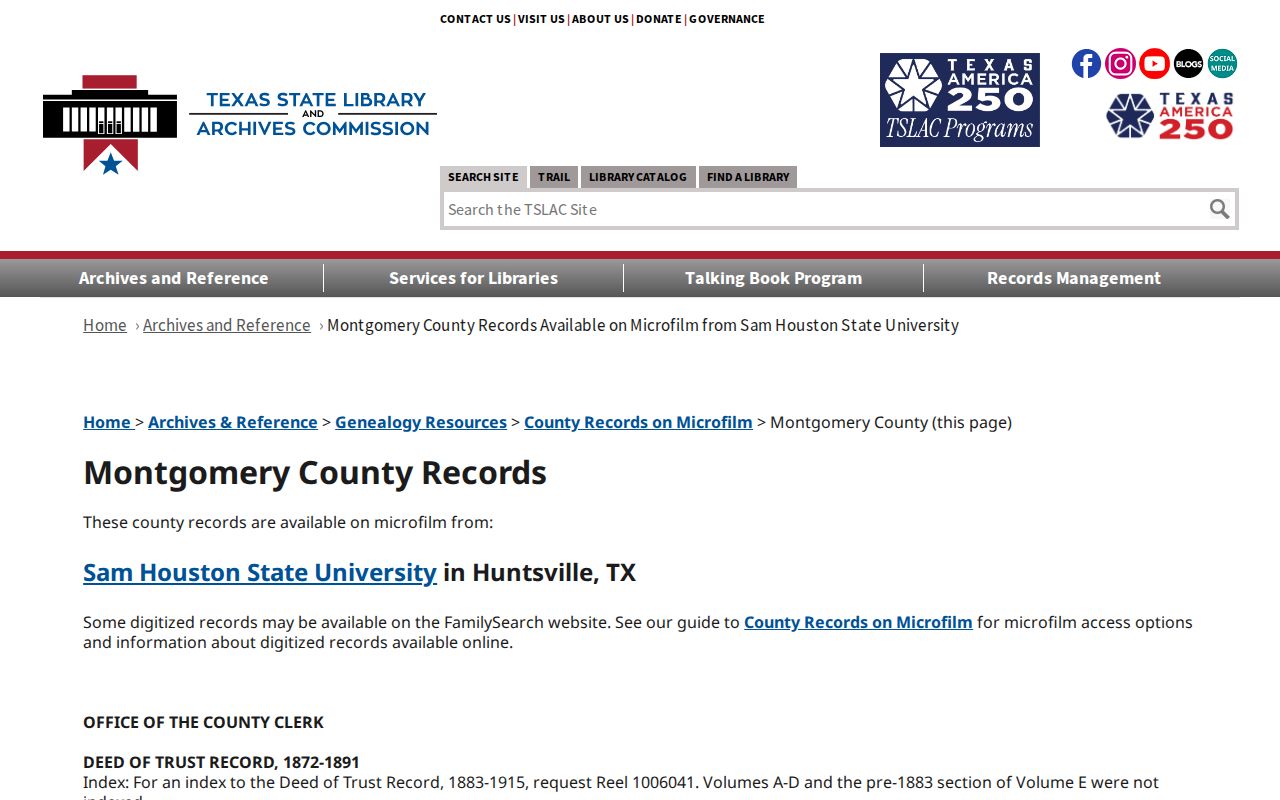
The reel information is a retrieval key, not a claim that the reel supplies an occupancy list or a digital image for every record.
Montgomery County Previous Residents in Microfilm
Early Montgomery County records can make a past-residents trail deeper than a modern parcel card. TSLAC lists marriage records from 1838 to 1916, probate minutes from 1838 to 1906, civil minutes from 1839 to 1908 in the main series, surveys from 1838 onward, and tax rolls from 1838 to 1910. Tax and probate material may explain a change in ownership, heirship, or a name change that a deed index alone leaves unclear.
Use each series for its actual purpose. A tax roll can connect a person to taxable land; a probate record can document an estate proceeding; a marriage record or newspaper may explain a household transition. None automatically proves a date of residence at a particular street address. Ask the repository how to access the reel, whether an image exists, and what volume or index is needed before making a request.
Montgomery County Past Residents in Print
Ownership is only part of an address history. Texas State Library holdings confirm Conroe city directories for 1984, 1988, 1990, and 1992. The MCMLS Genealogy & Local History Room can be asked about those volumes, reverse directories, yearbooks, local newspapers, obituaries, maps, vertical files, and exact call numbers. The Portal to Texas History also carries MCMLS material that includes a large Conroe Courier grouping and date facets from the 1870s through the 1940s.
Pair a directory year with the relevant census interval, a newspaper date, and a deed or tax date. A directory entry is a dated association, not a legal finding or proof that every person at an address was listed. No source inspected here confirmed an actual local entry or a local abbreviation key, so inspect the volume before interpreting household notation. The full collection details belong on the Montgomery County city directories page.
- Begin with the address and person name as printed in the target year's source.
- Check the confirmed directory years, then ask MCMLS or TSLAC about an additional volume, microfilm, clipping file, or lending option.
- Search Portal material by surname, street, business, and spelling variant, preserving the item date and page.
- Compare the date with census, deed, tax, probate, obituary, or marriage evidence before drawing a household conclusion.
Montgomery County Previous Residents on Maps
The Library of Congress offers a seven-sheet 1923 Sanborn map set for Conroe and a nine-sheet set dated 1938 through March 1943. Use a street intersection to find the right sheet. Then record the edition, sheet number, building footprint, construction, number of stories, and nearby features. Compare editions before assuming that a later address sits in the same form or location as an earlier one.
A Sanborn sheet can label a residence, store, garage, school, church, or other building use. It normally does not name who occupied the building. The map is therefore a context layer for past residents, best paired with a printed listing, newspaper mention, deed, tax roll, or probate record. Note: A map edition identifies physical context for its date, not a household roster.
Montgomery County Previous Residents Record Geography
County-seat and courthouse history can explain why a trail moves between repositories. Montgomery County was created in 1837. The county seat moved from Montgomery to Conroe after an 1889 election, and a courthouse followed in 1891. In 1933, a fire gutted the upstairs courtroom, while preservation material reports that citizens saved records. Repairs came in 1934, and the Art Deco courthouse was constructed in 1936.
Those events explain why older research may involve records from several places. They do not show that a specific property's file was burned or lost. Name the repository, document, date, and jurisdiction every time. A Conroe postal label, city boundary, and Montgomery County record jurisdiction may also differ, so retain the source's exact place description.
Montgomery County Previous Residents Privacy Limits
Use the smallest record set that answers the historic-address question. A deed identifies a recorded interest, while an appraisal card identifies a parcel and its displayed account data. Neither proves present occupancy, a personal relationship, or every resident of a household. Do not copy protected identifiers, victim information, juvenile material, sealed or expunged records, medical information, or a protected voter address. Respect redactions, account restrictions, and the office's stated channels.